

Events and Professional Education
The Official Members´ Periodical of the World Society of Victimology
Home > Publications > The Victimologist Volume 2 #2
Editors: The Editorial Board Jo-Anne Wemmers, Gerd Ferdinand Kirchhoff, Rika Snyman, Elmar Weitekamp
Vol. 2 #2
From the Editors Desk This issue of the Victimologist contains information on a variety of activities in and around the World Society of Victimology. The articles by Jan van Dijk and Bernard Jervis reflect the international contribution by the WSV and its members to improve the position of victims of crime and abuse of power. This theme can also be found in the President’s Message. Jan van Dijk provides an overview of recent developments concerning the WSV, including the meeting of the Executive Committee in May of this year. During the May meeting a number of decisions were made aimed at improving the WSV. A first step in this process is to compile a comprehensive overview of the WSV membership. Included in this issue of the Victimologist is a questionnaire which members are requested to fill in and return to Paul Friday. The Editorial Board of the Victimologist strongly urges all members of the World Society of Victimology to send in contributions for upcoming issues of The Victimologist. The Editorial Board is particularly interested in receiving articles from members concerning the implementation of the UN Declaration of Basic Principles of Justice for Victims of Crime and Abuse of Power in their own country. Contributions should be sent to the Managing Editor, Jo-Anne Wemmers, Ministry of Justice, P.O. Box 20301, 2500 EH, The Hague, The Netherlands. E-mail: crimprev@best-dep.minjust.nl Finally, the members of the Editorial Board would like to send their condolences to the family and friends of Marvin Wolfgang, who died in April of this year. The WSV is indebted to him for his important contribution to the field of victimology.
Leading Figure in Criminologyand Victimology Marvin E. Wolfgang Died Elmar Weitekamp, Ester Lafair, William Laufer and Neil Weiner.
Marvin E. Wolfgang, 73, Professor of Criminology, Legal Studies and of Law at the University of Pennsylvania, and a world renowned criminologist and victimologist, died of pancreatic cancer, according to a family member, on Sunday, 12 April 1998 at the Hospital of the University of Pennsylvania in Philadelphia. He was the Director of the Sellin Center for Studies in Ciminology and Criminal Law, which he named after his mentor and intellectual father, Thorsten Sellin. As a pioneer of quantitative and theoretical criminology, Professor Wolfgang defined the boundaries of the sociology of crime. In 1994, the British Journal of Criminology acknowledged Professor Wolfgang as "the most influential criminologist in the English speaking world". His research and critical commentaries appear in more than thirty books and one hundred and fifty articles. Among his most influential works are Patterns in Criminal Homicide (1958), The Measurement of Delinquency (with T. Sellin, 1964), The Subculture of Violence (with F. Feracutti, 1967), Delinquency in a Birth Cohort (with R. Figlio and T. Sellin, 1972). Professor Wolfgang was proud to have supervised the next generation of criminologist and victimologists, including close to 100 doctoral students, many of whom are deans, chairs and professors at universities and institutions on every continent of the world. Academics and practitioners from many disciplines acknowledged his forty-six years of dedication to his field by electing Professor Wolfgang as President of the American Academy of Political and Social Science, President of the American Society of Criminology and to Membership in the American Philosophical Society. He was the Associate Secretary General of the International Society of Criminology, a consultant to the President’s Commission on Law Enforcement and Administration of Justice, a member of the U.S. Department of Health, Education and Welfare’s Panel of Social Indicators, the Director of Research for the Presidential Commission on the Causes and Prevention of Violence, a member of the Advisory Committee on Reform of the Federal Criminal Law and a member of the National Commission on Obscenity and Pornography. Professor Wolfgang was the recipient of two Guggenheim Fellowships, a Fulbright Scholarship, the Dennis Carrol Prize fro the International Society of Criminology, the August Vollmer Research Award from the American Society of Criminology, and the Roscoe Pound Award from the National Council on Crime and Delinquency for distinguished contribution to the field of criminal justice. He also received the Hans von Hentig Award from the World Society of Victimology, the Edwin Sutherland Award of the American Society of Criminology, and the Beccaria Gold Medal for outstanding contribution to criminology from the German, Austrian and Swiss Society of Criminology. Professor Wolfgang was the first recipient of an award established in his name by Guardsmark, Inc. for distinguished achievement in criminology. Professor Wolfgang’s work encompassed scholarship that moved courts and legislatures to embrace principles of social justice, and the most rigorous social science research. As a strong and thoughtful opponent of the death penalty, he was gratified that his research findings were used in the landmark U.S. Supreme Court decision of Furman v. Georgia. Until his death, he was engaged in a ten-year, longitudinal study of juvenile delinquency in the People’s Republic of China, based on his cohort studies in Philadelphia and San Juan. Such cooperation between China and the West is a fitting testament to his prominence throughout the world. Marvin E. Wolfgang was born on 14 November 1924 in Millersburg, Pennsylvania. He received the bachelor of arts degree from Dickinson College in Carlisle, Pennsylvania in 1948, the master of arts in 1950, and the doctor of philosophy in 1955 fro the University of Pennsylvania. During World War II, he served in the U.S. Army in Italy. He Began his teaching career in 1948 at Lebanon Valley College in Annville, Pennsylvania and joined the faculty of the University of Pennsylvania in 1952, where he continued teaching until his recent illness. He received honorary doctor of law degrees from the City University of New York and the Academia Mexicana de Derecho Internacional, and was a visiting professor at the University of Cambridge, State University of New York at Albany, Hebrew University and Rutgers University. Few scholars live long enough to see their own legacy achieve such magnitude. For thousands of undergraduate and graduate students, that legacy is to follow in the Wolfgang tradition. Dr. Wolfgang is survived by his wife, Dr. Lenora D. Wolfgang, professor of French at Lehigh University; two daughters, Karen Swanson of Bronxville, New York and Nina Wolfgang, two grandchildren, Kirk and Kyle Swanson; and one sister, Patricia Mignogna of Lynchburg Virginia.
WSV UPDATE
Jan van Dijk
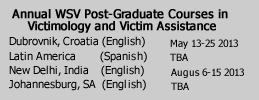
Caring for Crime Victims During the winter months Ron van Kaam, Jo-Anne Wemmers and myself finalised the proceedings of the Amsterdam symposium. The publisher Criminal Justice Press advised us to publish a not too heavy book, consisting of the keynote lectures, a limited selection of the most representative papers and the symposium reports. The first chapter of the book introduces the subject matter of victimology to less or uninformed readers. The title of the book will be Caring for Crime Victims. We expect the book to be available in the summer and hope it will reach a wide audience. The WSV will publish a larger selection of papers at a later stage in our own series of publications. Solidarity with Algerian children On March 15th I chaired, as WSV president, a symposium on the chronic exposure of Algerian children to terrorist violence. The symposium was attended by both Algerian and Dutch victim support experts and practitioners and received much attention from the Dutch media. As follow up to the symposium the War Trauma Foundation International has offered a two week training course for 12 Algerian psychologists in The Netherlands which will take place in August this year. Two Algerian children with severe injuries will be given orthopedic treatment in The Netherlands. We will continue to support the work of the organisers as president of their scientific committee. Executive board meeting On May 15th the Executive Board held its annual meeting in Dubrovnik (Croatia). Dubrovnik was chosen as the site of the meeting in order to allow the participants to lecture at the annual course in victimology which took place at the Inter University Centre in Dubrovnik in the same period. After the meeting several board members, including myself, travelled to Sarajewo to participate in a conference organised by the Bosnian Society of Victimology. At the board meeting the newly appointed treasurer, Paul Friday - who took over from Hans Schneider and his wife after two decades of dedicated service - announced his plans for the future. The Schneiders have managed to assemble for our society a reserve fund of 30.000 DM. One of Paul’s initiatives will be to offer members the option to pay their dues by credit card to a US account. More than four hundred persons have registered as members. The board feels that this number could and should be increased. We will soon start a membership drive. Past presidents will be approached to explore opportunities for donations from the business sector. On the basis of a report of Helen Reeves, the decision was made to strengthen the work of the society and involve more members in its activities by establishing several committees. Each of the committees will elect its own chairpersons and secretaries. The president and secretary of the society are ex officio members. First of all the Research Committee was re-established. The following members have agreed to participate in this committee: Prof. Marc Groenhuysen (NL; chair), Kristiina Kangaspunta (Finland/UN; secretary), Dr. Graham Farrell (USA), Dr. Joanna Goodey (UK), Prof. Per Stangeland (Malaga), Dr. Elmar Weitekamp (Germany), Dr. Marianne Loschnig (Austria) and Dr. Jo-Anne Wemmers (NL/Canada). The committee had its first meeting on 18 May, also in Dubrovnik. The committee will draft a research agenda - a list of emerging issues in victimological research which will offer guidance to researchers as well as to potential funders. The RC will also serve on the international scientific advisory committee of the tenth Symposium. Other committees which were established will look at the organisation of the society and at the recruitment of new members. A questionnaire will be sent to the members about their personal details and professional status. This questionnaire will also contain questions about ongoing research projects designed by the research committee. Another committees which will shortly be established will deal with the UN declaration and related issues (chaired by Irvin Waller). As members will be invited Leroy Lamborn (USA), Matti Joutsen (Finland/UN) and Ashley Oliver (USA). Helen Reeves (UK) will take the initiative to set up a committee which will try to establish an international network of victim services. The EC also decided to formally incorporate the Dubrovnik course into the society by establishing a committee on International Courses in Victimology. Courses will be held next year in Dubrovnik, Mito (Japan) and Chili. Members who are willing to serve on any of these committees are kindly invited to contact me or the relevant chairpersons. As the secretary-general explained to the board, the president is authorised to appoint members of committees. I will of course do this in consultation with the chairs of the committees. At this moment we are in particular looking for members who would like to serve on the UN committee. This committee will look at the victim policies of the UN - in 1999 the UN’s crime commission will for example discuss best practices concerning policies to address domestic violence. Another pressing task for the committee is the monitoring of victim-witness protection at international criminal courts. Proposals to include victim provisions in the convention on the International Criminal Court have met with strong opposition from some countries, including Japan. If the proposals are indeed rejected during the final negotiations this summer in Rome victims of war crimes will suffer from secondary victimisation and will be reluctant to testify for the new court. It would also signify a historical defeat for the international victims movement. The board received a report from the organisers of the tenth Symposium in Montreal in 2000. The organising committee has set up an organisational infrastructure and started its fund-raising. The theme will be Beyond Frontiers: research and action for the third millennium. The day themes will be Rights and duties in the area of victimisation; preventing victimisation; ethics and victimisation and secondary victimisation. The board noted with satisfaction that much progress has been made and expressed its full confidence in the organisers. The hope was expressed that victims of abuse of power/war crimes will be given sufficient room on the agenda. Sarajevo As said, several board members including myself left after the meeting for Sarajevo to attend an international conference on victimology. The conference was organised by the Society of Victimology of Bosnia and Herzegovina Some of the organisers have lectured at the Amsterdam symposium (e.g. Prof. M Kreso, Prof. S. Cekic and Prof. A Habib). John Dussich has been in contact with them for some time, with a view to establishing an Institute of Victimology in Sarajewo. During our stay meetings were hold in the evenings to discuss the objectives and organisational structure of such an institute. John and I would like the institute to be involved in action-oriented research. We want it to make a contribution to the delivery of concrete services to victims in the region and possibly also to the reconciliation procedures initiated by the United States Institute of Peace. Bernard Jervis (a retired Justice of the Peace form New Zealand who offered to help us launch the institute as volunteer) has been appointed as acting director of the institute to be. The institute will hopefully be formally launched later this year. Other members have also indicated their interest to do voluntary work for the Institute. Elsewhere in this issue the reader will find a report on the conference. I will limit myself to a few personal impressions. The unique character of this conference is self evident. The conference was part memorial service and part a first attempt at understanding. The bus trip to Sarajevo brought us along villages with many ruined houses. Some villages were completely deserted as a result of ethnic cleansing We also passed the city of Mostar, heavily damaged by the Croatian army. The destroyed historical bridge of Mostar symbolises the splitting of the nation into isolated parts. In Sarajevo most of the larger buildings still showed signs of heavy shelling and many of the city parks were transformed into cemeteries. According to current estimates 300.000 civilians or eight percent of the Muslim population has been killed during the war. Many thousands of women have been raped, during captivity or otherwise, apparently as part of the ethnic cleansing campaign of the Bosnian-Serb army and police forces. As I said in my intervention at the conference, it is too early to understand how these mass-scale victimisations will influence victimology but it seems certain that its impact on our field of study will be deep and lasting. More than in the past victimologists will want to address human rights abuses, including mass sexual violence. Victimology will have to come to terms in particular with the brutal killing of thousands of civilians after the fall of the safe area of Srebrenica. The tortured and massacred civilians of Srebrenica are not only victims of war crimes committed by the Bosnian Serb army. They are also victims in the quintessential sense that they were sacrificed for political and military reasons by the international community (the UN in particular). At the conference many speakers ventilated their anger about these and other injustices inflicted upon the Bosnian people. Several papers were given about attempts to assists survivors, including witnesses to The Hague Tribunal. One of the local speakers, also spoke about the need to analyse the historical background of the crimes committed and about the need to find openings for reconciliation. All foreign participants were overwhelmed by the extent and depth of human suffering exposed at the conference. It will take victimologists a long time to come to terms with these new instances of genocide in Europe at the turn of the millennium. How could this happen in our times, how can it be prevented in the future and how can we be of help to the survivors? Let’s hope that the soon to be opened Sarajewo Institute of Victimology, which will be affiliated with WSV, can help us to find some of the answers to these pertinent questions.
10th International Symposium on Victimology Research and Action for the Third Millennium August 6 - 11th 2000 Montreal, Canada For more information contact: Prof. Dr. Marie-Marthe Cousineau, School of Criminology and International Centre for Comparative Criminology (CICC), C.P. 6128 succ. Centre-Ville, Montreal, H3C 3J7 Canada E-mail: Cousinem@ere.umontreal.ca
Crime Victims and the United Nations - A Report on the Seventh Session of the Commission on Crime Prevention and Criminal Justice of the UN, Vienna 21-30 April 1998: A Plan of Action
Jan van Dijk
In 1985 the UN’s General Assembly adopted the Declaration on the Basic Principles of Justice for Victims of Crime and Abuse of Power. This adoption was a milestone for the victims movement and for the WSV, which played a major role in its preparation, in particular. The victims declaration is not an international convention which imposes legal obligations on member states. However, by adopting the declaration the member states have expressed their unanimous support for the principles contained in it. They have thereby committed themselves to use and apply these principles in national legislation and practices as much as possible. The declaration is part of the UN catalogue of standards and norms for crime prevention and criminal justice. Other examples are the minimum standards for prison management, juvenile justice and non-custodial measures. The development and maintenance of these standards and norms is traditionally one of the main tasks of the United Nations Crime Prevention and Criminal Justice Programme. The governing body of this programme is presently the UN Commission on Crime Prevention and Criminal Justice, one of the functional committees of the Economic and Social Committee (ECOSOC). ECOSOC reports directly to the General Assembly. The 35 members of the so-called Crime Commission are elected by the ECOSOC to sit on the commission for three years. Delegations of other governments can fully participate in the deliberations of the commission but have no vote. The administrative agency servicing the work of the commission is the Centre for International Crime Prevention in Vienna (previously the division). At the last session of the commission the newly appointed director-general responsible for the centre - the Italian criminologists Pino Arlacchi- informed the commission of his plans for reforming and streamlining the crime programme. According to these plans the UN’s crime programme will focus its activities on the fight against transnational organised crime. It was suggested in some of the preparatory documents that victim issues might become the exclusive concern of the Human Rights programme in Geneva. The commission decided after some informal and formal consultations that transnational organised crime would indeed be the present main priority issue but that a balance needs to be maintained with the other priority issues such as standards and norms. This decision which was strongly supported by the European Union Presidency (the UK) on behalf of the union, is important for the WSV because it implies that both the commission and the centre as well as the institutes affiliated with the crime programme will continue to pay attention to the victims declaration and other victim issues in the coming years. The challenge for the coming years will be to make work for victims as practicable as possible and, where possible, to link this up to the present priority issue of transnational organised crime . In my view the new priority can easily be reconciled with continued attention for victims issues. It goes without saying that the fight against organised crime should always include respect and care for the victims. The repression of alien smuggling or trafficking in women should not result into the criminalisation or secondary victimisation of the objects of such activities. Since 1995 the WSV has collaborated with the Centre in Vienna in drafting an ambitious plan of action for the implementation of the victim declaration. Elements of the draft plan of action were the preparation of a handbook on the implementation of the declaration, the establishment of a database/resource centre for best practice and the establishment of an International Fund. The draft plan of action requested governments and the UN to take initiatives to implement the declaration world-wide, in particular also with regard to the prevention of human rights abuses. At the commission meeting in 1996 the draft plan of action was judged to be over-ambitious, considering the financial crisis of the UN. There is also some reason to suspect that some governments are less than eager to commit themselves to fully implementing the declaration. No government was ready to ask for the adoption of the plan of action. In consultation with Irvin Waller, president of the WSV, the delegation of the Netherlands submitted a resolution which asked for the adoption of at least some elements of the draft plan of action, notably the preparation of a handbook. This more modest resolution was eventually adopted by the commission and ECOSOC. On the basis of this resolution a working group was convened by the Office of Victims of Crime of the US Department of Justice and NOVA to start the work on a handbook. Several board members of the WSV took part in this work. It was decided that the use and application of the Declaration would be best served by the drafting of two different documents : a guideline for policymakers and a handbook on justice for victims for practitioners. These two documents were finalised during meetings hosted by the Ministry of Justice in The Hague and the Office of Victims in Washington respectively. At the meeting in Vienna in April this year the commission adopted a resolution, submitted by The Netherlands and Brazil, which inter alia, welcomes the Guide for Policymakers and the Handbook on Justice for Victims. It urges the Centre to translate both documents in all official UN languages and to disseminate them widely. The English versions will shortly be published by the UN. Due to the help of several WSV members, the policy guide - a thirty pages document which advises policymakers how best to implement the Declaration - is also available in seven other languages. However, the Centre in Vienna will need financial support for the translation of the handbook in other languages. Maria de La Luz of Mexico has promised to arrange a translation of the handbook into Spanish. The resolution contains several other elements which are of great relevance for the WSV. The governments of the USA has offered to establish an international training programme which will assist policymakers and practitioners in working with the guide and the handbook. Also welcomed in the resolution is the offer of the government of the Netherlands to establish a databank on best practice in victim legislation, case law and victim support for an initial duration of three years. The databank will be made available on the Internet later this year, building upon the experiences of the website for the Amsterdam Symposium. The website will be managed by Ron van Kaam, who many WSV members will remember as organiser of the Amsterdam symposium. It is envisaged that the website will offer several new opportunities for communication between WSV members. The resolution in addition welcomed the proposal to convene a working group of interested parties to explore the feasibility of establishing an International Fund for Victims which could, for example, support the establishment of victim assistance services in developing nations. Mr Pieter van Vollenhoven, husband of Princess Margriet of Orange and for many years chief fund-raiser for victim support in the Netherlands, has agreed to chair the first meeting. Interested members are kindly invited to contact me and supply us with examples of projects worth funding. At the request of the Finnish delegation, the resolution finally requests the Centre in Vienna to seek the views of Member States on a revised draft plan of action, with a view to reporting on it to the commission during its meeting in 2000. The upshot of this request is that in 2000 the commission will consider whether or not it wants to adopt a plan of action. In 2000 the commission’s meeting will coincide with the tenth congress of the UN on crime. Both events will take place in Vienna. One of the main themes of the congress will be the fair treatment of victims and offenders. It will be the task of the WSV to collaborate with the Centre and the UN institutes in the preparation of this congress and, more specifically, to draft a plan of action which is both useful and acceptable for the commission. More attention should, I think, be given to the protection of victims of transnational organised crime as well as to the protection of victims as witnesses at national and international criminal courts.
Victimology Symposium 9-10 May 1998 Sarajevo
Bernard Jervis
The two-day symposium held in Sarajevo, hosted by the Society of Victimology Bosnia and Herzegovina, covered a wide range of victim issues relating to acts of aggression and violations of human rights during the war in Bosnia and Herzego- vina [1992-1995]. From the 44 papers presented at the symposium and ensuing discussion a picture was clearly drawn of the devastation caused by this war in human terms - missing persons, torture, rape, homelessness, orphans, refugees, destruction of property and sacred places, and evidence of mass executions. The symposium sought solutions on how best to meet the various needs of these victims. In this, the first task will be to know the full extent and nature of victimisation in Bosnia and Herzegovina and what present legislative provision is in place to protect victims from harm and the access they have to the criminal justice system. Similarly it is necessary to know what provisions exist in providing programmes of assistance and support, as well as practical considerations relating to damaged property and homelessness. To address all these issues and find possible solutions is a task that will exercise a great deal of thought, research, anguish, and energy over the coming years. William Steubner of the US Institute of Peace gave an important presentation on the proposed Truth and Reconciliation Commission to be established in this region later this year. The following extract is succinct in its appraisal of the task ahead and gave focus to these two days: "A nation emerging from massive repression, abuse and trauma, if it is going to proceed forward in a healthy way, needs to find appropriate ways of doing that, but to naively assume that individuals and groups who have been victims of hideous atrocities will simply forget about them and expunge their feelings without some form of accounting is probably to leave in place seeds for future conflict. It is a long-term process and a complicated one. In many of the cases, it is a process that will take longer than the amount of time allotted for peacekeeping troops to separate warring parties or to begin the technical work of disarmament in the peace process. This is a time-consuming and delicate procedure that needs to proceed appropriately and will vary from case to case. But a public airing of some sort, some kind of public recognition of what went on previously and some kind of a societal consensus is essential." Special appreciation must be given to the Society of Victimology Bosnia and Herzegovina, the World Victimology Society, the University of Sarajevo and community representatives. This symposium was made possible by funding from the Netherlands Government. It is hoped that the goodwill found at the Symposium will be carried forward into the many tasks that lie ahead. Further information on the Institute of Victimology in Sarajevo can be obtained from the Director of the Institute, Bernard Jervis, on e-mail instvikt@bih.net.ba or tel/fax [071] 212 858.
WSV Membership Survey
Please help us accurately review our records for the next issue of the Membership Directory. We are also interested in knowing more about our members so that we can better serve your needs. Please complete the following and return to the treasurer: Prof. Paul C. Friday, Department of Criminal Justice, University of North Carolina-Charlotte, Charlotte, NC 28223, USA Please Print or Type your name and the address to which you want WSV materials sent. Check here if you do NOT want your address printed in the Membership Directory business Private Title: Mr. Ms. Dr. Prof. Title: Mr. Ms. Dr. Prof. Name: _____________________ Name: _______________________ Affiliation:____________________________________________________ Street____________________ Apt___Department:____________ Street: ___________________ City: ______________________________ Postal Code/City: ___________ Postal Code/City: ____________________ State/Country:______________ State/Country:______________________ Telephone: + ( )______________ Telephone: + ( )______________ FAX: + ( )______________ FAX: + ( )______________ email: _________________________ email: _________________________ Please give us the following information about yourself. Which of the following describe the work do you? Check all that apply. Profession Training Academic Criminal Justice Government Agency Director/Worker Education Police officer/Law Enforcement Law Researcher Social Work, Psychology Victim Advocate Sociology Victim Assistance/ Services Director/worker Other: ___________________ Victim Crisis/ emergency worker Student Other: _______________________________ Are you interested in serving on committees or in other ways working in the Society? Yes No Are you currently conducting victimological research? Yes No If yes, please give the title or primary topic area(s): _______________________________________________________ _______________________________________________________ What services or support would you like the Society to provide you in the future? ______________________________________________________ Please attach a letter if you have additional comments or suggestions.